
Cart
Your cart is empty!
Home
→
Pressotherapy after exercise: recovery and leg comfort
Pressotherapy after exercise: recovery and leg comfort
Pressotherapy after exercise: recovery and leg comfort
Publication source: Gesberg.eu
A good workout continues with attention to recovery. After running, strength exercises or an active day, your legs may need some extra rest. Pressotherapy — a device-assisted massage using air-filled cuffs — helps make time for this stage: rhythmic compression supports the movement of fluid through the tissues and may reduce feelings of fatigue. Let us look at how it can be used in post-exercise recovery and how a home session with Gesberg Presso Health can fit into your routine.
Why your legs need rest after a workout
Squats, leg presses, treadmill running, cycling and team sports place different demands on the muscles. During movement, the muscles contract actively and circulation adjusts to the tissues’ increased needs. After exercise ends, the body continues to replenish its energy resources and adapt to the workload. This is why the time between workouts matters just as much as a well-planned exercise programme.
Post-exercise sensations also vary: general fatigue, heavy legs, stiffness or soreness after unfamiliar activity. The latter is often noticed the following day, especially after exercises involving a pronounced lowering phase or downhill running. This is delayed-onset muscle soreness, often called DOMS. It is not explained by lactic acid being “trapped” in the muscles, so promising to remove it through massage oversimplifies the actual recovery processes.
For a recreational exerciser, the practical aim is simple: allow the body to recover and make rest comfortable. You do not have to be preparing for a marathon to pay attention to this. After returning to the gym, taking an unusually long walk or doing your usual workout after work, it helps to assess how you feel and plan a calm end to your activity.
How movement, lymph flow and pressotherapy are connected
The lymphatic system helps return fluid from between the tissues to the bloodstream. Body movement and muscle activity help move this fluid. In pressotherapy, air chambers provide an additional external action: they inflate and deflate according to a set programme, alternating pressure and release. This principle is called intermittent pneumatic compression, or IPC.
Leg cuffs distribute the action across several areas, from the foot to the lower leg and thigh. This makes the procedure feel like a sequential massage that wraps around the leg. The method is used to support venous return and fluid movement; where a medical condition is involved, a professional determines the indications and regimen. A home recovery session after sport should take account of your health and the instructions for the particular device.
In a 2026 study of healthy adults, pneumatic compression was followed by changes consistent with fluid redistribution and increased tissue oxygen saturation in the treated area. This helps explain the physiological mechanism of the procedure. The study examined the immediate tissue response, rather than the time needed to return to training, and used different equipment.
How pressotherapy can help with post-exercise recovery
One of the effects most readily understood by users is a change in how they feel after exercise. Rhythmic cuff compression and release may help reduce feelings of heaviness and muscle fatigue. The person rests with their legs supported, without performing additional exercises, and can calmly move from training to recovery.
This effect has also been examined in sports research. In a randomised study of ultramarathon participants, overall muscle fatigue immediately after pneumatic compression was lower than after resting while lying down. The study did not find a lasting advantage over the following days.
A 2024 systematic review covering 17 studies also identified the potential of IPC to relieve perceived muscle pain and soreness after exercise. The size of the effect varied with the conditions. A reasonable aim for home treatment is therefore to support recovery and leg comfort; a feeling of relief alone does not yet mean that strength has fully recovered or that you are ready for maximum effort.
In everyday life, this can be quite straightforward: finish exercising, change clothes, settle on the sofa and set aside time for a massage. This routine suits people who exercise regularly and want to give rest as much attention as training. Pressotherapy can be included as an additional way to care for the legs.
Manual lymphatic drainage and device-assisted massage: what is the difference?
During manual lymphatic drainage, a practitioner uses their hands and adapts the technique to the condition of the tissues. In pressotherapy, the cuff chambers provide the action and the device programme determines the massage pattern. Both approaches involve fluid movement and compression, but they are performed differently. Research on IPC cannot automatically be applied to every manual technique, or vice versa.
The advantage of a home device is the convenience of arranging a session. There is no need to book an appointment each time: you can prepare the equipment at home and use it in a calm setting. However, choosing a procedure for persistent swelling, after surgery or for a lymphatic condition requires an individual assessment. Routine fitness recovery and the treatment of a diagnosed condition are different tasks.
Read more about how it works in the article “Description of the Pressotherapy Method”.
A home session with Gesberg Presso Health
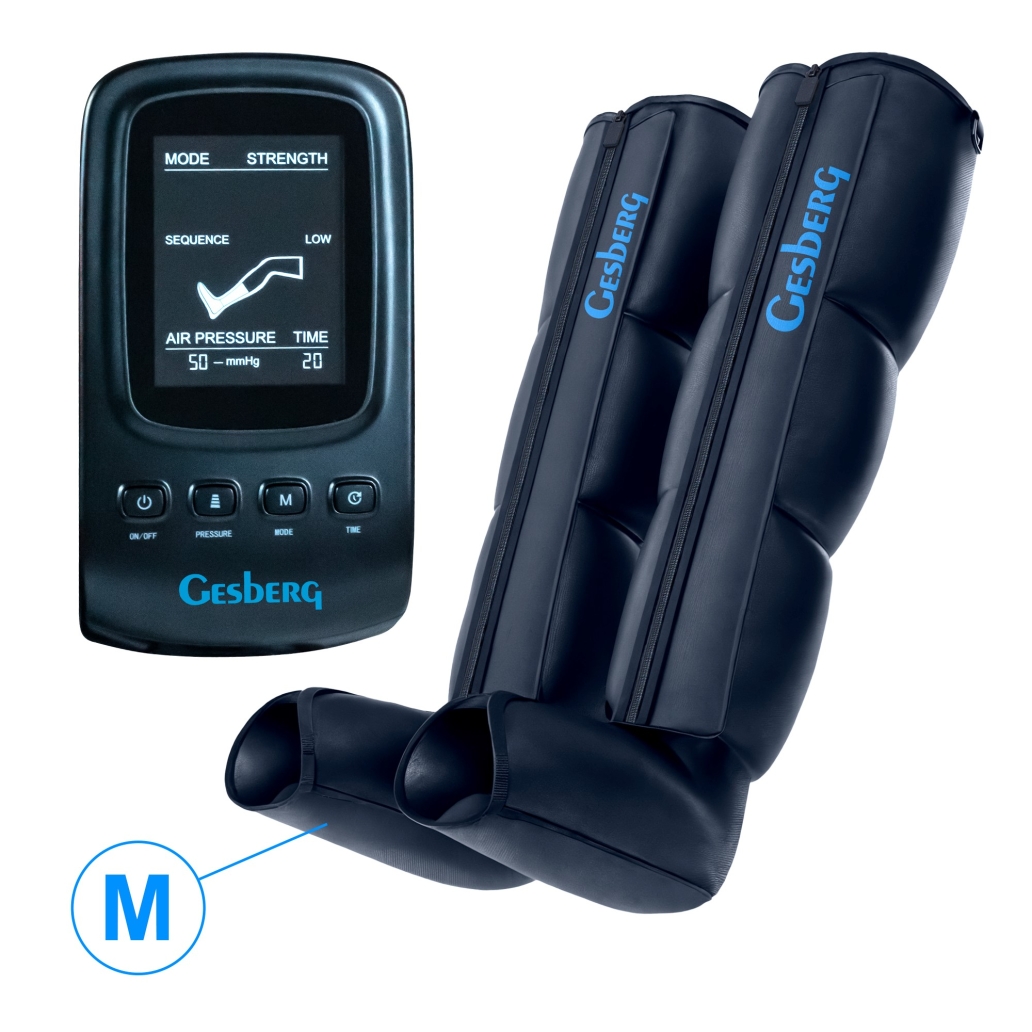
Gesberg Presso Health comes with a control unit and two leg cuffs. Each cuff has four air chambers; there are three massage programmes and a timer for 20, 25 or 30 minutes. A display and physical buttons let you choose the settings, and the compact set is easy to put away after use.
Choose a comfortable seated, reclining or lying position for your session. Your legs should be supported, the cuffs should fit correctly and the zips should be fully closed. Connect both cuffs according to the instructions and check the connections. Start with low pressure and aim for a comfortable sensation: stronger compression is not a goal in itself. The timer can be set for 20, 25 or 30 minutes.
During the procedure, you can rest quietly or listen to music. Stop the session if you experience pain, numbness, unusual squeezing or feel unwell. When finished, switch off the device and remove the cuffs. It is useful to assess the procedure by your own comfort and plan your next training day with your overall condition in mind.
Pressotherapy at home with Gesberg Presso Health
Make time to rest your legs after a workout.
How to include pressotherapy in your recovery routine
Start with the overall picture: how demanding the exercise was, how tired you feel and when your next session is planned. A hard leg workout may require more rest than your usual walk. Do not try to use the procedure to compensate for an overly abrupt increase in training volume. Consistency and manageable exercise help establish a sustainable routine.
A practical sequence is to finish exercising calmly, rehydrate, eat according to your usual plan and allow time for rest. You can add a pressotherapy session when you are ready to settle comfortably and are not in a hurry. There is no need to choose a “sports” pressure setting yourself based on someone else’s protocol: studies use different devices, while at home the instructions for your own model are the guide.
Sleep remains an important part of recovery. Allow enough time for it, particularly during periods of increased exercise. A balanced diet and replacing lost fluids are also part of the overall plan. Device-assisted massage fits well alongside these habits: it adds dedicated time for leg rest without requiring you to change your entire routine.
When to seek advice first
Consult a professional beforehand if you have recent bone, joint or skin injuries in the massage area, reduced sensation, serious illness, fever, a flare-up of a chronic condition or implanted electronic devices that may be sensitive to external influences. If you have a diagnosed vascular or heart condition, discuss a suitable regimen with your doctor as well.
Sudden swelling in one leg, redness, unusual pain or marked local warmth calls for medical assessment rather than self-massage. If these symptoms occur with shortness of breath or chest pain, seek urgent help. Compression methods are also used in medicine, but this does not make home use appropriate for every symptom.
Frequently asked questions
Is pressotherapy suitable after an ordinary fitness session?
It can be considered as an additional procedure for leg comfort after your usual physical activity, provided your health permits its use. Focus on how you actually feel and your need for rest, rather than treating it as something that must be done after every workout.
Should I choose the maximum pressure?
No. Start at a low level and increase it gradually, guided by comfort. Pain and excessive squeezing are not signs of a beneficial effect.
Can I do another hard workout immediately after a session?
That decision depends on recovery as a whole: muscle soreness, mobility, sleep, fatigue and your training plan. Pleasant sensations after massage are not, on their own, a test of readiness for another demanding session.
Make room for recovery in your schedule
Pressotherapy helps turn post-exercise rest into a clear and convenient home routine. Supporting fluid movement, rhythmic massage and the opportunity to relax the legs make it a useful addition to recovery after an active day. Choose suitable settings, pay attention to how you feel and maintain a balance between training and rest. Discover Gesberg Presso Health and choose a set for home use.
Sources
- Maia F. et al. Effects of lower-limb intermittent pneumatic compression on sports recovery: A systematic review and meta-analysis.
- Hoffman M. D., Badowski N., Chin J., Stuempfle K. J. A Randomized Controlled Trial of Massage and Pneumatic Compression for Ultramarathon Recovery.
- Aoyagi M. et al. Effects of intermittent pneumatic compression device on the improvement of tissue oxygen saturation and fluid clearance at the compression site.
- Schwahn-Schreiber C. et al. S1 guideline on intermittent pneumatic compression (IPC).
- Schwane J. A., Watrous B. G., Johnson S. R., Armstrong R. B. Is Lactic Acid Related to Delayed-Onset Muscle Soreness?
- Walsh N. P. et al. Sleep and the athlete: narrative review and 2021 expert consensus recommendations.
- Rabe E. et al. Risks and contraindications of medical compression treatment – A critical reappraisal. An international consensus statement.