
Cart
Your cart is empty!
Home
→
Pressotherapy cuffs: how many chambers?
Pressotherapy cuffs: how many chambers?
Pressotherapy cuffs: how many chambers?
Number of Chambers on Pressotherapy Cuffs – 4,6,8,12. Which Is Better?
Important
This article is for informational purposes only. The information is intended for general familiarization and does not replace consultation with a specialist.
Introductory information: what is this about in general
In pressotherapy, a cuff is not just a “shell” that presses on a leg or arm. It is a tool that creates a compression wave, which moves from bottom to top, imitating the work of the muscle pump. The quality and effectiveness of lymphatic drainage massage depend on the construction and quality of execution of the cuff. It is precisely here that there is a fundamental difference between cheap home and professional devices — and it is not in the number “number of chambers” on the label, but in how these chambers and cuffs are constructed.
Two types of cuff construction: simple seam versus tile overlap
Type 1: Simple seam.
The most common variant of cuff construction is two layers of airtight fabric, which are divided into sections by gluing or stitching the upper (outer) layer and the lower (inner) layer. Technologically, this is the simplest and cheapest way to divide the space inside the cuff into sections.
The more such seams there are, the more independent chambers can be obtained in the cuff. In turn, it is obvious that the more chambers there are, the smoother and more accurate the compression wave can be obtained.
At first glance, everything looks logical, but this is where the problem lies. With such a construction, each seam between chambers creates a narrow “dead zone” — an area that receives no pressure from any of the chambers. This happens because when air is supplied, the section tends to take the shape of a circle (if viewed in cross-section), and the edges of each section rise away from the surface of the body. For example, with 4 chambers in the cuff, there are 3 such zones, and their length is insignificant in relation to the entire length of the cuff. But with 6, 8 or more chambers, the number of seams and, accordingly, untreated areas increases many times over.
A paradoxical situation arises: more chambers in a cuff with a simple seam — worse massage quality. The compression wave becomes intermittent, non-uniform, with “gaps”. This is the case when a greater number of chambers makes the massage less high-quality.
In practice, with such a cuff construction, 3-4 chambers for a leg cuff is optimal. A larger number of chambers is a marketing move, for this cuff construction, unjustified by consumer characteristics.
Type 2: Tile overlap (professional devices).
In professional devices, the chambers are constructed fundamentally differently. And the cuffs consist not of two layers, but of at least 4 layers. Each chamber in such a construction is a separate construction that is not rigidly connected to the neighboring chamber. And the chambers are arranged in such a way that each next chamber partially overlaps the previous one — like tiles on a roof or fish scales. Thanks to this, there is no “dead zone” between neighboring chambers: each section of the limb surface is under the influence of at least one chamber at any moment in time.
With such a construction, increasing the number of chambers really makes sense. The compression wave becomes smoother, more uniform and physiological — it more accurately copies the natural peristalsis of lymphatic and venous vessels. The pressure transition between sections occurs gently, without sharp drops, which improves both the therapeutic effect and patient comfort.
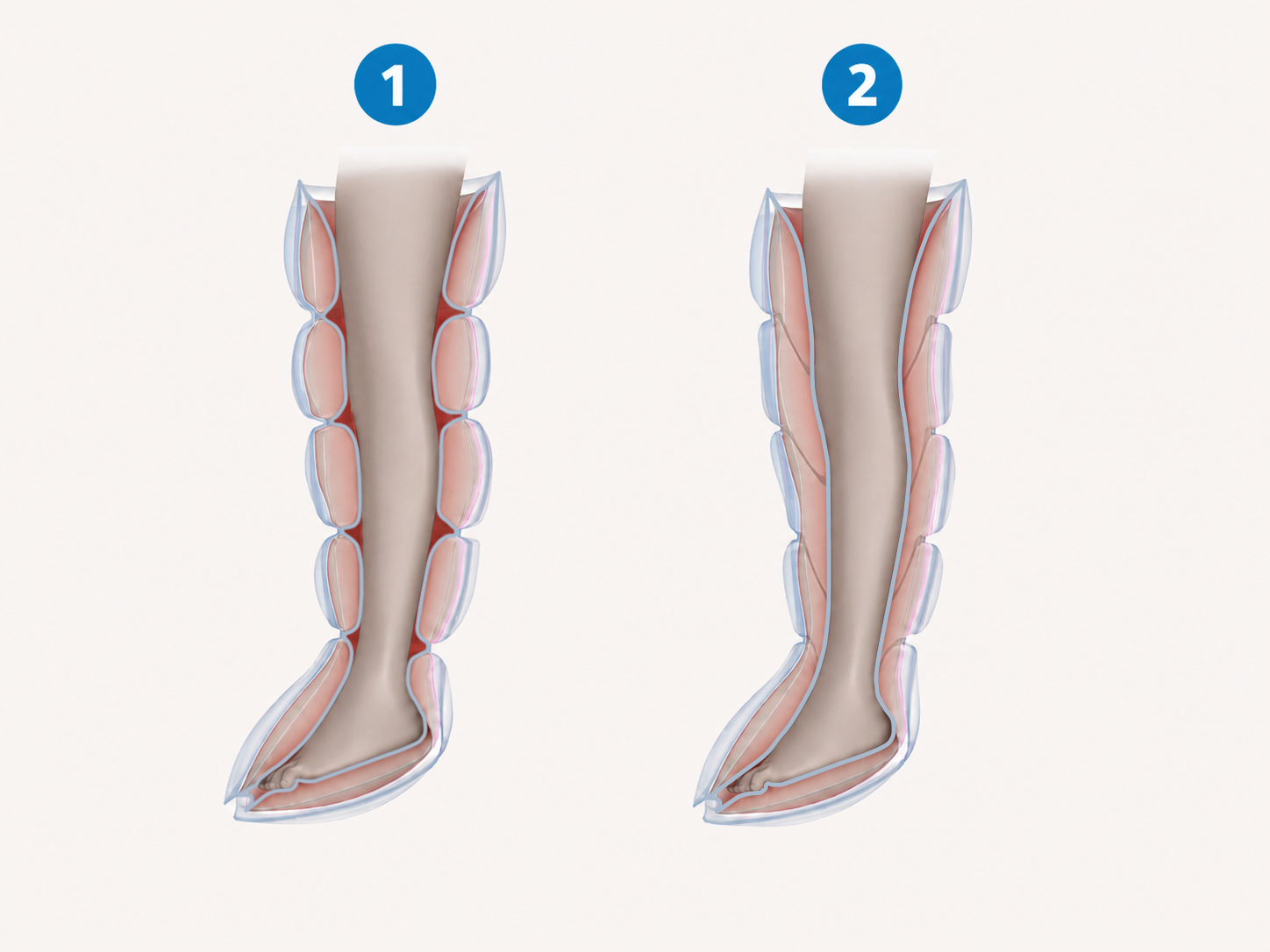
Comparison of the two types of construction
| Parameter | Cuffs with a separating seam between chambers | Cuffs with tile overlap of chambers |
|---|---|---|
| Device type | Budget / home | Professional |
| Construction | Chambers are separated by a glued seam | Chambers overlap each other |
| “Dead zones” | Present — at each seam | Practically absent |
| Effect of additional chambers | Increases the number of “dead zones” | Makes the wave smoother |
| Wave quality | Intermittent, with “gaps” | Uniform, physiological |
| Optimal number of chambers | Up to 4 with a simple seam. A larger number of chambers is unjustified. | 4 or more. A larger number of chambers is justified. |
What this means in practice when choosing a device
In the characteristics of pressotherapy devices, emphasis is often placed on the number of chambers as the main indicator of quality. In fact, this is a secondary parameter. Much more important are:
- What type of chamber construction is used — with a separating seam or with tile overlap?
- Are there pressure sensors that ensure uniform compression in each section?
The answers to these questions will give a much more accurate idea of the quality of the device than just the number on the packaging.
Brief conclusion
- In budget devices - cuffs with a simple seam are predominantly used. With such a construction, the optimum is no more than 4-5 chambers.
- In professional devices - as a rule, cuffs with tile overlap of chambers are used. In such devices, a greater number of chambers is justified and improves the quality of massage.